Scaffold banners earn their keep high up and out in the open, which is exactly where wind becomes one of the biggest factors in how well they perform. The material you choose is not simply a question of price or appearance. It is a question of how that banner behaves when the weather turns.
Wind load is one of the biggest considerations when choosing a scaffold banner material, especially on large, tall or exposed sites. We supply both mesh and PVC scaffold banners every day, so this guide explains how each option copes with wind, where each material makes sense, and what that means for the scaffold structure itself.
By the end, you will have a clear idea of whether mesh, PVC or PVC Airmesh is the right choice for your site.
Why wind is the real deciding factor on scaffolding
Scaffolds are tall, exposed and rarely tucked away from the weather. Fix a large printed banner across one, and you create a flat surface for the wind to push against. On a sheltered shop front, that pressure may be minor. Several storeys up on an open construction site, it can become a serious consideration.
A banner that traps wind tugs hard at its fixings and transfers that force into the scaffold structure. In the worst cases, it can tear loose, which is both a costly failure and a genuine safety risk to anyone below. Many scaffold licences and site safety requirements take wind loading into account for this reason.
Choosing the right banner material is the first step in keeping that force under control. For larger scaffold banners, wind should usually take precedence over print sharpness, weight, or price.
What is the wind load on a scaffold banner?
Wind load is the force created when wind pushes against the surface of a banner. The larger and more solid the banner face, the greater the pressure transferred into the fixings and scaffold structure.
On exposed scaffolding, especially multi-storey projects, excessive wind load can strain fixings, cause banners to billow or tear, and increase stress on the scaffold itself. This is why mesh materials are widely used on construction sites. They allow air to pass through the printed surface rather than acting like a sail.
Mesh scaffold banners use a similar airflow principle to scaffold debris netting and temporary scaffold sheeting, helping reduce wind pressure across large elevations.
How mesh scaffold banners handle wind
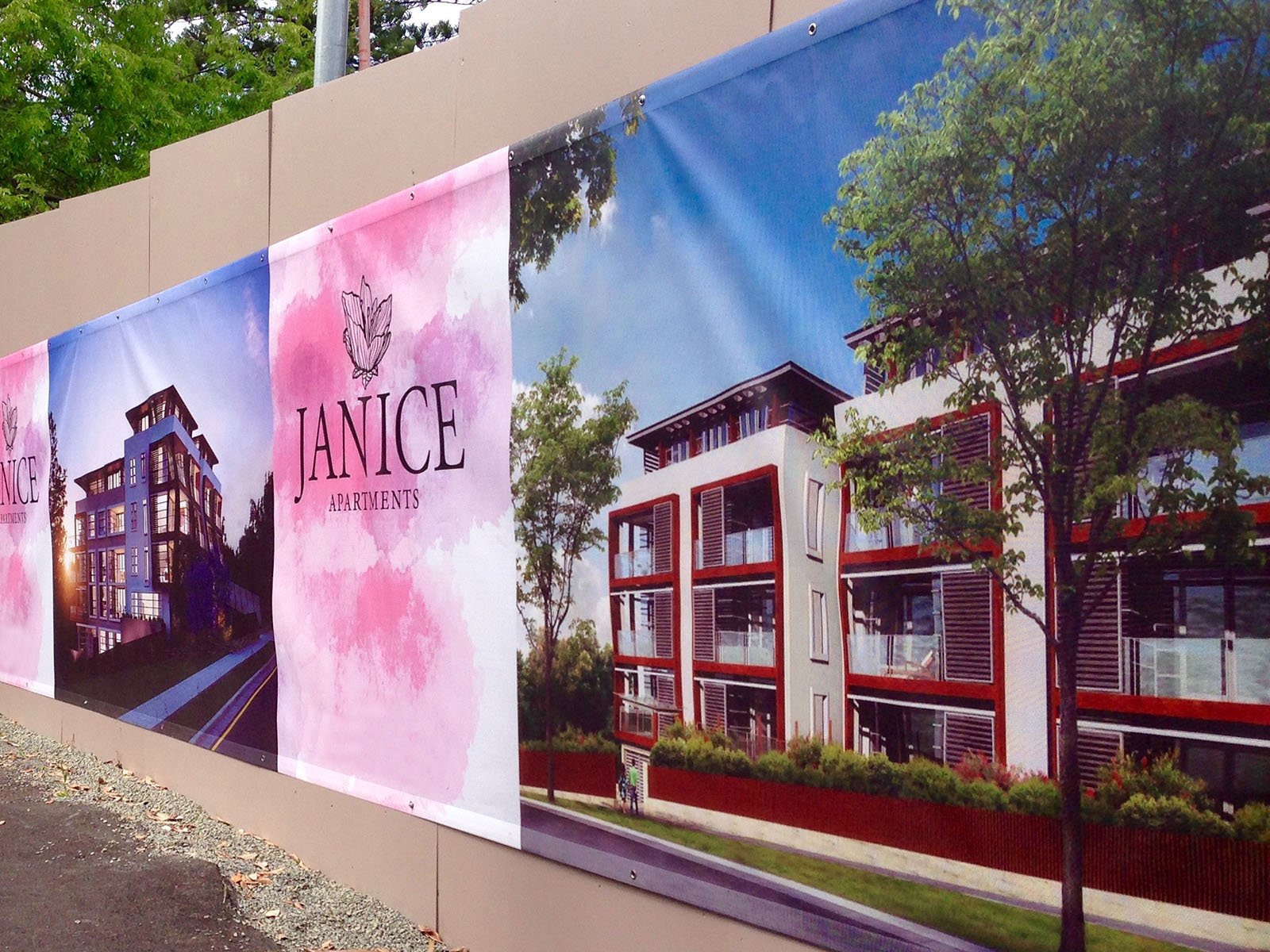
Mesh is a PVC-based material covered in thousands of tiny perforations. These small holes let air pass through the face of the banner rather than catching it as a solid sheet. The result is far lower wind resistance, which helps protect both the banner and the structure it is fixed to.
That airflow brings several practical advantages. The banner pulls less violently in gusts, so the print, hems and fixing points are placed under less strain. The material is also lighter than solid PVC, which matters on tall facades where every kilogram adds up.
Mesh can also be produced in much larger sizes without the wind risk climbing as quickly as it would with solid PVC. For large scaffold elevations, open sites, long-term construction projects and exposed locations, mesh is usually the sensible default. That is why our mesh scaffold banners are one of the most popular options for construction work.
When standard mesh is not enough: PVC Airmesh
For the most exposed sites, standard scaffold mesh can be stepped up to PVC Airmesh. This material is lighter and more open than standard mesh, with larger perforations that let even more air and some light pass through the banner’s face.
That extra airflow makes it our go-to option for high-rise wraps, coastal sites, hilltop locations and any project where strong gusts are a major concern. Billowing, flapping, and the risk of the banner ripping are all reduced, while far less strain is placed on the fixings and the scaffold structure.
If wind exposure is your main concern, our PVC Airmesh banners are the strongest option in the range.
Where PVC scaffold banners still earn their place
Solid PVC is not the wrong material. It simply has a different sweet spot, usually smaller scaffold banners.
Solid PVC has a smooth, unbroken face, so colours appear richer and fine details, such as logos, phone numbers, web addresses, and contractor information, stay sharp and easy to read. A smaller banner offers less surface area for the wind to catch, so the main drawback of solid PVC is far less of an issue at modest sizes.
That makes PVC a strong choice for scaffolding firms advertising their own services, contractor contact boards, safety notices and compact signs where the message needs to be crisp rather than huge. It can also be printed double-sided, with a block-out layer in the middle to stop one design from showing through to the other. This is useful where a smaller banner or sign will be seen from both directions.
Our heavy-duty PVC scaffold banners are well-suited to this type of work. The important point is that the larger and higher the banner goes, the more its solid face fights the wind. For large, exposed scaffold wraps, PVC is usually the wrong tool for the job.
Mesh vs PVC scaffold banners: quick comparison
| Feature | Mesh Scaffold Banner | PVC Scaffold Banner |
|---|---|---|
| Wind resistance | Excellent | Lower |
| Airflow | Allows air through the banner face | Solid face with no airflow |
| Print sharpness | Good at normal scaffold viewing distance | Excellent for close-up detail |
| Best suited to | Large, tall or exposed scaffold banners | Smaller signs and close-range advertising |
| Weight | Lighter across large areas | Heavier across large areas |
| Double-sided printing | Limited | Available |
| High-rise scaffold use | Recommended | Usually not recommended for large exposed areas |
Print quality, weight and sizing compared
There is a trade-off for all that airflow, and it is worth being clear about it. Because mesh is perforated, the print is not quite as dense as it is on solid PVC. Up close, you can see the texture of the material. At normal scaffold viewing distance, from across a street or several floors below, the eye fills in the gaps, and the design still reads clearly.
For most large site banners, that difference in print density simply does not matter. The banner is viewed from a distance, and the main priorities are usually visibility, scale, and safe outdoor performance.
Weight is another important consideration. Mesh is noticeably lighter than solid PVC over a large area, reducing strain on the facade and making handling and fitting easier. The pattern is simple: solid PVC suits smaller banners read close up, where sharpness matters and size keeps wind risk under control. Mesh suits larger, higher, more distant and more exposed banners.
If you want a wider look at the two materials beyond scaffolding, our guide to mesh vs PVC banners covers the general comparison in more detail.
Fixings and finishing for scaffold banners
However good the material is, a scaffold banner is only as secure as its fixings. The right finishing method helps spread the load, reduce strain, and keep the banner stable through changing weather conditions.
Choosing the right finish
Reinforced pole pockets are the toughest option for larger scaffold banners. These pockets are welded and then stitched so the banner can be threaded onto a scaffold tube, spreading the load along the edge rather than concentrating it at a few small points.
Hem and eyelets are the flexible alternative, allowing the banner to be fixed at intervals with cable ties or bungee cord. As a rule, the larger and more exposed the banner, the more fixing points you need. They should be spaced evenly so no single point takes too much strain.
Large-format building wraps and scaffold banners often use reinforced pole pockets to distribute wind pressure more evenly across the structure. If you are planning a larger wrap, our building wraps range may also be worth reviewing.
It is also worth checking the fixings during long-term projects. A banner that works loose in bad weather is far more likely to fail before the print or material itself has reached the end of its life.
Mesh or PVC? A quick decision guide
Choose mesh, or PVC Airmesh for the most exposed jobs, when the banner is large, high up, left in place for a long period or fitted to an open scaffold elevation where wind load is a concern.
Choose PVC for smaller scaffold banners that need sharper close-range print, such as scaffolding company advertising, contractor contact boards, safety signs, double-sided signs and sheltered short-term jobs.
When in doubt on a large or exposed scaffold, mesh is usually the safer call.
Frequently asked questions about mesh and PVC scaffold banners
Are mesh scaffold banners better in the wind?
Yes. Mesh scaffold banners are generally much better in windy conditions because the perforated material allows air to pass through the banner face. This reduces the sail effect and places less strain on the banner, fixings and scaffold structure.
What is the safest banner material for scaffolding?
For large, tall or exposed scaffold banners, mesh is usually the safer choice. PVC Airmesh is better again for very exposed sites because it allows even more airflow through the banner.
Can PVC scaffold banners be used on high-rise buildings?
Small PVC scaffold banners may be suitable in some situations, but large solid PVC banners should be carefully assessed for use on high-rise or exposed scaffolding. Because PVC has a solid face, it catches more wind than mesh and can create a higher wind load.
What is PVC Airmesh?
PVC Airmesh is a more open version of scaffold mesh with larger perforations. It is designed to allow more air to pass through the banner, making it especially useful for high-rise wraps, coastal sites, hilltop locations, and other exposed projects.
Do scaffold banners increase wind load?
Yes. Any banner fixed to scaffolding can increase wind load because it creates a surface for wind to push against. The level of wind load depends on the size, height, exposure and material. Mesh reduces this effect compared with solid PVC.
How should scaffold banners be fixed?
Scaffold banners should be secured with suitable finishing options, such as reinforced pole pockets or hem and eyelets. Larger and more exposed banners need more fixing points, spaced evenly, so the strain is spread across the banner rather than concentrated in one area.
Our verdict on scaffold banner material
For most scaffold work, and certainly anything large or exposed, mesh is the material we recommend. It copes with wind far better than solid PVC, protects both the banner and the structure, and is lighter and easier to manage across large elevations.
PVC Airmesh is the upgrade for the highest wind exposure. It is the best choice for high-rise wraps, coastal locations and open sites where gusts are likely to be severe.
Solid PVC still earns its place, especially for smaller scaffold banners where sharp print, rich colour and double-sided visibility are more important than airflow. It is ideal for compact advertising signs, contact boards and short-term sheltered use.
The honest answer is that the right choice depends on the size, height and exposure of the job in hand. If you would like advice for a specific site, take a look at our full range of scaffold banners or get in touch for a quote, and we will point you towards the material that suits the job.